Physical Address
304 North Cardinal St.
Dorchester Center, MA 02124
Physical Address
304 North Cardinal St.
Dorchester Center, MA 02124


Colic in horses is a major problem and a headache for horse owners as well as all stakeholders in the equine industry. Colic is defined generally as pain in the abdominal cavity or area of the horse.
The pain of any kind found in the abdomen of the horse qualifies as colic, however, colic is generally perceived to be problems associated with the gastrointestinal tract of the horse.
This perception holds because the horse has a unique digestive system that is prone to cascades of events that lead to more complications. Therefore attending to minor problems relating to the intestine such as mild colic in time is very important. For the purpose of our discussion, we will focus on intestinal colic (colic associated with the gastrointestinal system).
The 3 types of intestinal colic are gas colic, obstructive lesions, and functional obstruction as classified by the school of veterinary medicine, University of Illinois.
Gas colic: the digestion in horses involves fermentation which produces gas, in situations where there is an overproduction of gas, mild to moderate colic can result. The prognosis for this type of colic is good and it is easy to treat medically.
Functional obstruction: this type of colic occurs when there is a physiological derangement such that there is no physical obstruction but the GIT movement (peristalsis) ceases. Ingesta, therefore, does not move to cause pain or colic in the said horse
Obstructive lesions: this happens when there is a physical obstruction in the GIT of the horse such as impaction, twisting, or strangulation of the intestines. Impaction can be treated medically and has a positive prognosis depending on how soon it is attended to. Strangulation or twisting of the intestine in most cases requires surgery. An example is the case of Puma
A call came through around 7:00 am complaining of colic in Puma. The Veterinary team visited quickly to attend to Puma. Puma was reportedly normal the previous day and was even ready to play a tournament in a few hours before she was seen showing signs of abdominal pain(colic). Puma was observed showing signs of colic around 5am. Flunixin had been administered already
PHYSICAL EXAMINATION:
RECTAL PALPATION
DIFFERENTIAL DIAGNOSIS
TREATMENT PLAN
Puma died because there were limited facilities for surgical intervention.
POSTMORTEM FINDINGS
DISTENDED ABDOMEN
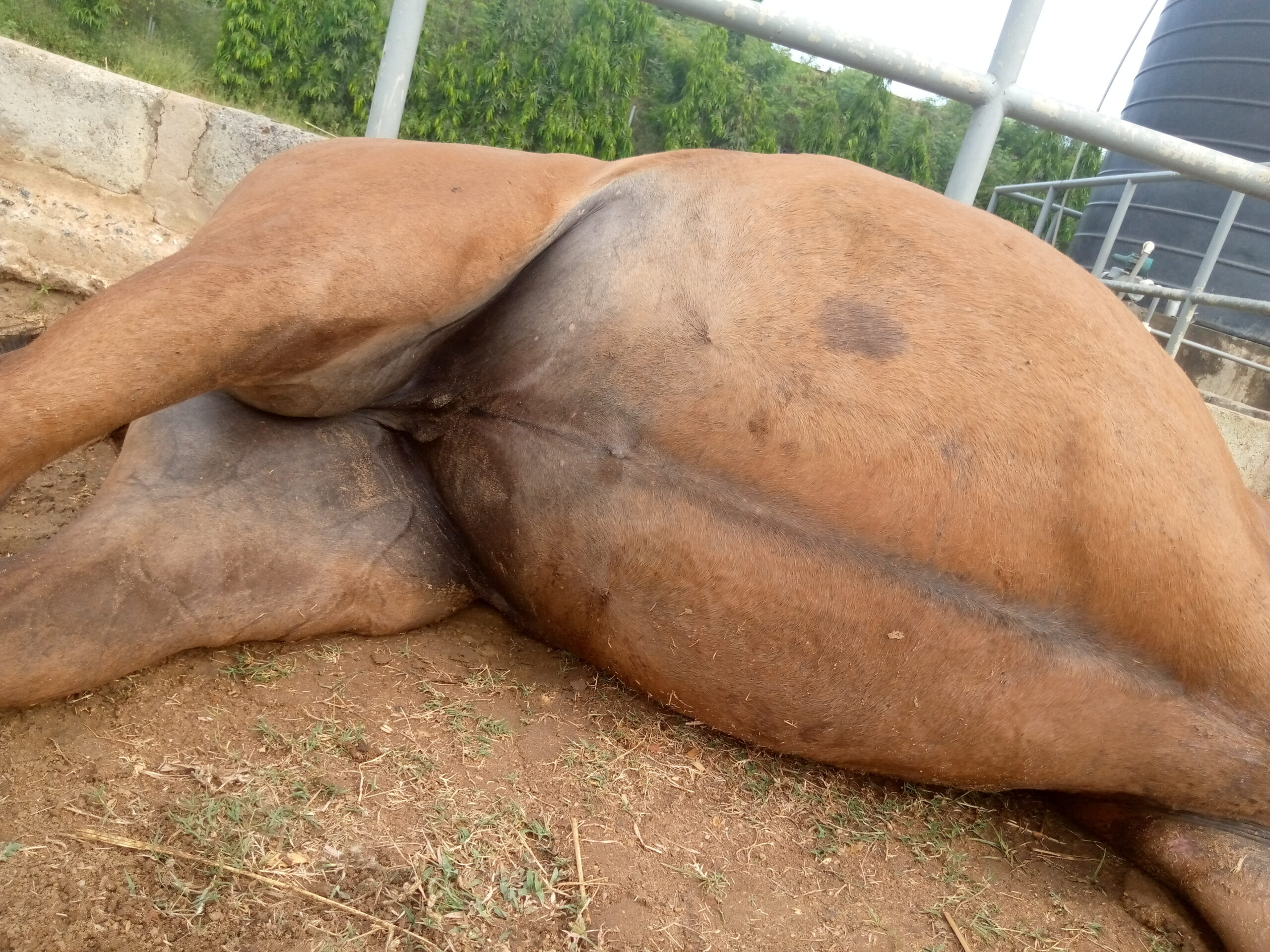
GAS FILLED CAECUM(BALLONED CEACA)- contact us for detailed images
NECROHAEMRRAGIC PARTS OF CAECUM-contact us for detailed images
VISSIBLE TORSION/TWISTING OF THE INTESTINE-contact us for detailed images
CONGESTED PART OF THE CAECUM DISTAL TO THE POINT OF TORSION-contact us for detailed images
INTERPRETATION
There was torsion of the caecum which prevented the normal flow of ingesta in the digestive system of the horse. This led to a build-up of gas (ammonia) in the caecum manifesting as the ballooning of the caecum and distending of the abdomen.